
Der Fachverlag für Wissenschaft und Hochschule
Shop
Ergebnisse 101–120 von 769 werden angezeigtNach Aktualität sortiert
-

Das Spannungsfeld zwischen Wissenschaftsmanagement und Hochschulverwaltung: Eine analytische Betrachtung (ePaper)
Abstract: This article analyses the tension between science management and university administration against the backdrop of increasing external demands. Based on the „bridge technology“ thesis, structural, functional and cultural-normative dimensions are considered. The analysis reveals different patterns of legitimacy: while university adminis-tration legitimises itself through compliance with rules, science management must prove its effectiveness through…
10,95 € -

Hochschulmanagement – Ausgabe 2025|3+4
Beiträge in diesem Heft Sparte: Organisations- und Managementforschung Christiane Maue, Olivia Laska & Robert Aust Zwischen Bürokratie und Innovation: Widerstände als Schlüssel zum erfolgreichen Wissenstransfer S. 69-74 Michael Hölscher & Philipp Komaromi Die Rolle des Hochschulmanagements im Wissenstransfer: Ergebnisse der bundesweiten Befragung unter Professor*innen im Projekt WIDEN S. 75-82 Susan Harris-Hümmert, Julia Rathke & Jana…
0,00 € – 50,00 € -
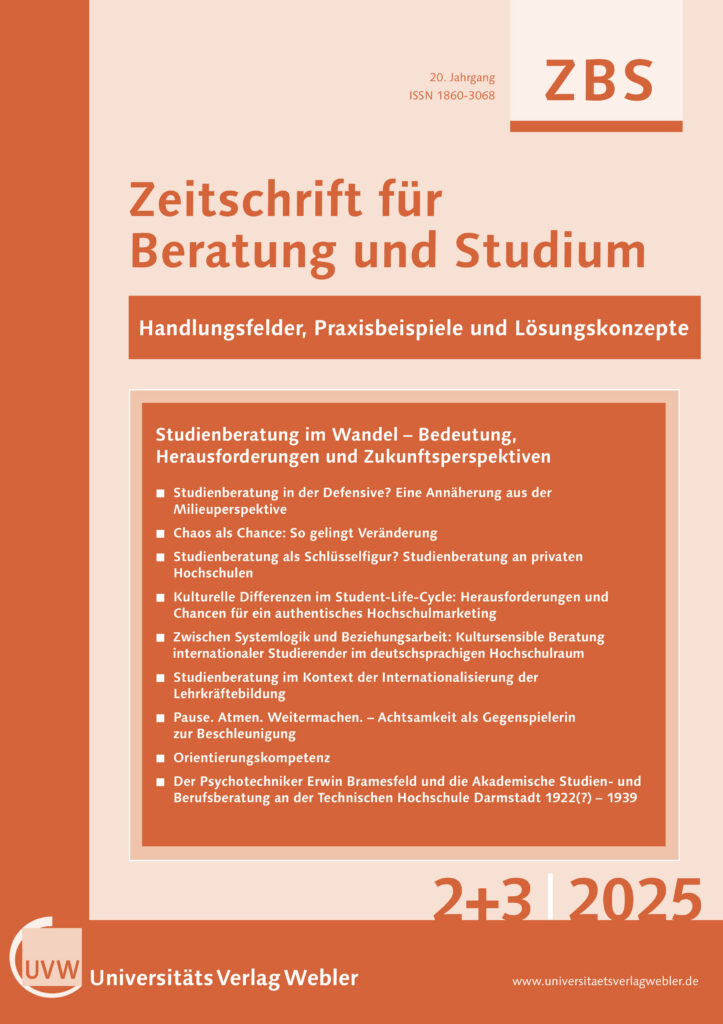
Zeitschrift für Beratung und Studium – Ausgabe 2025|2+3
Beiträge in diesem Heft Sparte: Themenschwerpunkt Martin Schmidt Studienberatung in der Defensive? Eine Annäherung aus der Milieuperspektive S. 35-41 Lena Bamberger & Jutta Müller Chaos als Chance: So gelingt Veränderung S. 42-45 Aline Fuß & Stefanie Kessler Studienberatung als Schlüsselfigur? Studienberatung an privaten Hochschulen S. 46-50 Felix Christian Kolb Kulturelle Differenzen im Student-Life-Cycle: Herausforderungen und…
49,00 € – 50,00 € -

Das Hochschulwesen – Ausgabe 2025|5+6
Beiträge in diesem Heft Sparte: Hochschulforschung Sebastian Schneider, Frederic Krull & Justus Henke Das Spannungsfeld zwischen Wissenschaftsmanagement und Hochschulverwaltung: Eine analytische Betrachtung S. 127-137 Julia Reuter & Anja Mallat Sorgen im ‚Vorzimmer‘ – Position und Positionierung von Hochschulsekretärinnen S. 145-151 Jule E. Westerheide Durchsetzung, Legitimation und Geschlechterstereotype in der Arbeitsbewertung – Konflikte um Leistungs- und…
40,00 € – 41,00 € -

Fo-Gespräch: Transdisziplinarität und ihre gesamtgesellschaftliche Bedeutung (ePaper)
Abstract: This discussion shows that transdisciplinarity is a field situated at the intersection of science and practice, and – due to its intersecting interests – a field fraught with controversy and misunderstanding. It is worth bringing more clarity to this issue: a) first, to clarify the term and its origins, b) to highlight the current…
8,95 € -

Digitale Geomedien und ihr Einsatz in Bildung für Nachhaltige Entwicklung: Transdisziplinäre Entwicklung als Grundlage für zielgruppen-zentrierte Lehr- und Trainingsmaterialien, Empfehlungen und Konzepte (ePaper)
Abstract: Technological advances and the digital transformation of society led to changes in education. For this reason, the use of digital geomedia in the educational sector is gaining increasing interest. This also applies to education for development (ESD), which is generally carried out as informal education. Now, to actually be used in the ESD, teaching…
7,95 € -

Zukunftsbilder in transdisziplinären Settings erarbeiten: Erfahrungen mit Zukunftswerkstatt und Participatory Systems Mapping (ePaper)
Abstract: Traversing disciplinary boundaries – transcending the confines of science – translating research excellence into social relevance on socially relevant topics: At a time when research and universities are responding to nothing less than grand challenges, transdisciplinarity is required. Accordingly, both academic disciplines and the higher education system strive for „science in and with society“,…
9,95 € -

Transdisziplinierung der Wissenschaft – zwischen Glanz und Elend (ePaper)
Abstract: Traversing disciplinary boundaries – transcending the confines of science – translating research excellence into social relevance on socially relevant topics: At a time when research and universities are responding to nothing less than grand challenges, transdisciplinarity is required. Accordingly, both academic disciplines and the higher education system strive for „science in and with society“,…
4,95 € -
Disziplinäre und transdisziplinäre Sozialwissenschaften: Distinktionen und Synergiepotenziale wissenschaftlicher Forschungs- und Transferleistungen (ePaper)
Abstract: In response to the mounting expectations placed on the social sciences to address social crises, there is a growing interest in transdisciplinary research formats. Transdisciplinarity is frequently regarded as an antithetical concept to disciplinarity. While disciplinary research is focused on the investigation of scientific questions under controlled conditions, to produce valid, reliable and objective…
8,95 € -

Reflexionen zum #ConnectingMinds-Programm des Wissenschaftsfonds FWF: Key Learnings im Kompetenzaufbau zu Transdisziplinarität (ePaper)
Abstract: The article provides a transnational perspective on the development and implementation of two calls issued by the Austrian Science Fund (FWF) for its transdisciplinary funding program #ConnectingMinds. Four key learnings are addressed: (1) the need for active program management to strengthen transdisciplinarity research (TDR) skills both within funding agencies and externally at research institutions;…
8,95 € -

Qualität in der Wissenschaft – Ausgabe 2025|2+3
Beiträge in diesem Heft Sparte: Anregungen für die Praxis/Erfahrungsberichte Sabine von Thenen, Sascha Brinkhoff & Cathrin Söllner Evaluationen transdisziplinär gedacht: Das Fallbeispiel Erasmus+ S. 35-41 Louise Schubotz & Sandra von Sydow Offene Lernangebote für eine KI-kompetente Hochschule? Innovation evaluativ begleiten und gestalten – transdisziplinäre Ansätze aus dem Projekt KI-Campus 2.0 S. 42-51 Nicole Schleicher, Stephanie…
49,00 € – 50,00 € -

Personal- und Organisationsentwicklung – Ausgabe 2025|2+3
Beiträge in diesem Heft Sparte: KI-Nutzung: grundsätzliche PE/OE-Aspekte Daniela Sommer & Henrike Schaum Zwischen Regulierung und Freiheit: Künstliche Intelligenz als Herausforderung für die Personal- und Organisationsentwicklung in wissenschaftlichen Einrichtungen S. 36-41 Franziska Schrade, Angela Kuonath & Dieter Frey Künstliche Intelligenz in der Wissenschaft: Eine empirische Erhebung des Personalentwicklungsbedarfs an der Ludwig-Maximilians-Universität München S.42-51 Emily M.…
49,00 € – 50,00 € -

Teilzeitprofessuren an privaten und staatlichen HAW: Geschlecht, Verteilung, Risiken und Chancen (ePaper)
Abstract: Part-time professorships enable knowledge transfer and can help universities of applied sciences to fulfill their missions. We analyze complete quantitative data from German universities of applied sciences. The results show significant differences in the proportions of part-time professors between public and private institutions, with half of all professors working part-time in the latter. Gender…
7,95 € -

KI-Kompetenzentwicklung für Promovierende: Ein Einblick aus der Praxis (ePaper)
Abstract: With the rapid spread of large language models (LLMs) such as ChatGPT, it has become clear that research processes themselves will also undergo change. This raises important questions about meaningful application scenarios, good scientific practice, and competence development. In our contribution, we take a practice-oriented perspective on how doctoral researchers can further develop their…
9,95 € -

Zukunft gestalten an der Universität Bonn: KI-Kompetenz als Hebel organisationalen Lernens (ePaper)
Abstract: In the wake of rapid developments in generative AI, universities are facing not only technological, but also cultural and structural transformations. Human resources development is called upon to create formats that not only impart individual knowledge, but also enable collective learning. At the University of Bonn, an innovative format called the ‘AI-Sprint’ has been…
6,95 € -

KI in Personal- und Organisationsentwicklung: Bedarfsgerechte Kompetenzentwicklung von Lehrenden und Mitarbeitenden in der KI Academy (ePaper)
Abstract: The rapid digitalization and integration of artificial intelligence (AI) in academia necessitate targeted upskilling of university staff. Since 2021, Biberach University of Applied Sciences addresses this via the KI-TEACH² project. Its AI Academy trains educators and staff across three competence levels: explorer – expert – multiplier. This model guides participants in selecting suitable training…
7,95 € -

Künstliche Intelligenz in der Wissenschaft: Eine empirische Erhebung des Personalentwicklungsbedarfs an der Ludwig-Maximilians-Universität München (ePaper)
Abstract: The growing use of AI is reshaping work, roles, and demands in academia. This exploratory study at LMU Munich examines AI usage, attitudes, competencies, and training needs among academic staff (N = 99). Results indicate that AI is used more in research than in teaching and self-organization. Regarding training needs, participants prioritized tools, legal…
10,95 € -

Zwischen Regulierung und Freiheit: Künstliche Intelligenz als Herausforderung für die Personal- und Organisationsentwicklung in wissenschaftlichen Einrichtungen (ePaper)
Abstract: The use of generative AI in scientific institutions raises questions beyond technical aspects, highlighting organizational and cultural dimensions. This article outlines key tensions arising from AI use in science, teaching, administration, and students, and emphasizes the role of personnel and organizational development (PD/OD) as moderator and designer of transformation. Introducing a model of digital…
6,95 € -

Der Psychotechniker Erwin Bramesfeld und die Akademische Studien- und Berufsberatung an der Technischen Hochschule Darmstadt 1922(?)-1939 (ePaper)
Abstract: Erwin Bramesfeld, born in 1893 in Barmen/Rhineland, studied mechanical engineering at the Technical University of Darmstadt, where he then started an academic career as head of a new established Psychotechnic Institute in the 1920s. (Psychotechnic can be considered as an early scientific branch to what nowadays is called business psychology.) He also was responsable…
9,95 € -

Orientierungskompetenz (ePaper)
Abstract: The pressure on students and prospective students to make a good and safe decision when choosing a course of study and career is high. The article discusses three orientation strategies. Degree orientation focuses on finding a specific career as a goal. Program orientation offers an all-inclusive package, like dual studies. Connection orientation focuses on…
6,95 €
Filteroptionen

Der Fachverlag für Wissenschaft und Hochschule
Reepeweg 5
33617 Bielefeld
0521 923610-0
info@universitaetsverlagwebler.de
Social Media
Rechtliches
Alle Preise inkl. MwSt.