
Der Fachverlag für Wissenschaft und Hochschule
Shop
Ergebnisse 21–40 von 769 werden angezeigtNach Aktualität sortiert
-
Vom Einzelbot zum KI-Ökosystem: Domänenspezifische KI-Werkzeuge als Organisationsstrategie im Wissenschaftsmanagement (ePaper)
Abstract: While AI in higher education is mostly discussed in terms of teaching and research, the operational side of science management – its rule-based, document-intensive, knowledge-dependent administrative work – remains overlooked. This article presents three domain-specific AI tools developed at the University of Kassel: KIRA (quality assurance of study programme documents), NOVA (doctoral procedures), and…
7,95 € -

Generative Künstliche Intelligenz im Wissenschaftsmanagement: Vom individuellen Einsatz zur Gestaltung von Verfahren (ePaper)
Abstract: This paper examines the role of generative artificial intelligence (AI) in higher education management from a procedural perspective. It argues that the effective use of AI depends less on technological capabilities than on the degree of process modelling. To structure the analysis, three levels of AI use are distinguished: individual application, organizational embedding, and…
7,95 € -
Orientierung in Zeiten der Erwartungsdynamik: Zur (Un-)Einheitlichkeit hochschulweiter KI-Leitlinien im Prüfungswesen (ePaper)
Abstract: Generative AI is fundamentally transforming examination practices at universities and increasing the need for institutional guidance. This article analyses 30 university-wide AI guidelines from German universities and examines how higher education institutions regulate the use of generative AI in examinations, focusing on recurring patterns in provisions concerning independence, transparency, academic misconduct, and the delegation…
8,95 € -
Wessen Gedanke ist das? Augmentierte Reflexivität und post-individuelle Autorschaft durch Zusammenarbeit mit generativer KI (ePaper)
Abstract: Discussions of artificial intelligence in higher education have so far revolved around tools, competencies, and regulation. This paper argues that such a perspective overlooks a deeper shift: generative AI changes not only what higher education institutions do, but how thinking itself takes place within them. Drawing on a governance development process at a Swiss…
0,00 € -

KI-Nutzung qualitätsgesichert lehren: Das AI Change Lab als studentisch entwickelte Konzeption zur Qualitätsurteilskompetenz (ePaper)
Abstract: This article presents the AI Change Lab as a literature- and discourse-based workshop concept for quality-assured teaching of generative AI use in higher education that has undergone initial formative testing. It responds to the gap between students‘ everyday use of AI tools and often abstract institutional rules. We propose quality judgement competence as a…
0,00 € -

Geteilte Führung im Zeitalter der KI: Mensch-KI-Entscheidungsarrangements und neue Führungsrollen im Hochschulmanagement (ePaper)
Abstract: This conceptual article examines how artificial intelligence (AI) transforms leadership structures in higher education organisations. As universities increasingly integrate AI into administrative and decision-making processes, leadership is no longer exercised solely by human actors but emerges within hybrid socio-technical arrangements. Drawing on transformational leadership theory and governance perspectives, the article conceptualises leadership as a…
7,95 € -

Qualität in der Wissenschaft – Ausgabe 2026|2+3
Tools, die auf künstlicher Intelligenz (KI) beruhen, sind inzwischen in fast allen Lebensbereichen zu finden. In den meisten Berufsfeldern, insbesondere auch im Bereich der Wissensarbeit, gehört die Nutzung von KI-Tools bereits für viele Menschen zum Arbeitsalltag. Dies schließt das akademische Feld mit ein. In Forschung, Lehre, aber auch im Wissenschaftsmanagement gibt es Anwendungsszenarien für KI.…
49,00 € – 50,00 € -

Das Familienzimmer als Impulsgeber für gelebte Vereinbarkeit. Wie Care, Bildung und Raumgestaltung Hochschulen verändern können (ePaper)
Abstract: The Family Room at Ostfalia University’s Faculty of Health Sciences exemplifies how care, education, and spatial design can drive transformative change in higher education. As a multifunctional space for students and staff with children, it promotes the compatibility of study, work, and family life while embodying a culture of inclusion and care. Grounded in…
7,95 € -
Care-Arbeit und Erwerbstätigkeit an Hochschulen. Ergebnisse einer Fachbereichsbefragung (ePaper)
Abstract: The compatibility of work and care responsibilities represents a key challenge for equality policy within the university context. Although this topic is increasingly addressed in public debates, there is often a lack of robust data and nuanced perspectives at the institutional level to develop targeted support measures. Against this backdrop, the Equality Council of…
6,95 € -

Personalstrukturen im deutschen Wissenschaftssystem. Der Reformvorschlag des Wissenschaftsrats und die Resonanz (ePaper)
Abstract: This article examines the German Science and Humanities Council’s (Wissenschaftsrat) 2025 position paper on personnel structures in the German academic system and its reception. The paper proposes a function-based reform introducing a new model with clearer, more diverse staff categories – including a new „science-adjacent“ (wissenschaftsnah) tier – to replace the existing opaque catch-all…
6,95 € -
Arbeiten am unteren Ende der Hierarchie. Wie ausbleibende Regulierung studentischer Erwerbsarbeit informelle Praktiken begünstigt (ePaper)
Abstract: Student employees are among the largest yet least researched groups within German higher education. Despite their importance they remain only partially integrated into the regulatory framework governing employment relations in the public sector. Drawing on concepts of labour relations, precarity, and informality, this article examines how different regulatory arrangements shape their working conditions. The…
8,95 € -
Hochschulen als Arbeitswelten. Unterschiede und Gemeinsamkeiten zwischen den nicht-professoralen Beschäftigtengruppen (ePaper)
Abstract: This article examines universities as diverse workplaces by comparing the working and employment conditions of academic staff, professional support staff, and student employees. Drawing on survey data from Technische Universität Berlin, it identifies substantial differences between these groups with regard to employment arrangements, perceived work-related strain, and opportunities for autonomy, while also highlighting challenges…
11,95 € -

Beschäftigungsregime an privaten HAWs. Eine Clusteranalyse des wissenschaftlich-künstlerischen Personals (ePaper)
Abstract: This paper examines the personnel and employment structures at private universities of applied sciences in Germany. Theoretically, the study draws on concepts of employment regimes routed in sociology of work and industry, as well as approaches to the governance of academic work. Based on data from the Federal Statistical Office, six employment regimes are…
10,95 € -
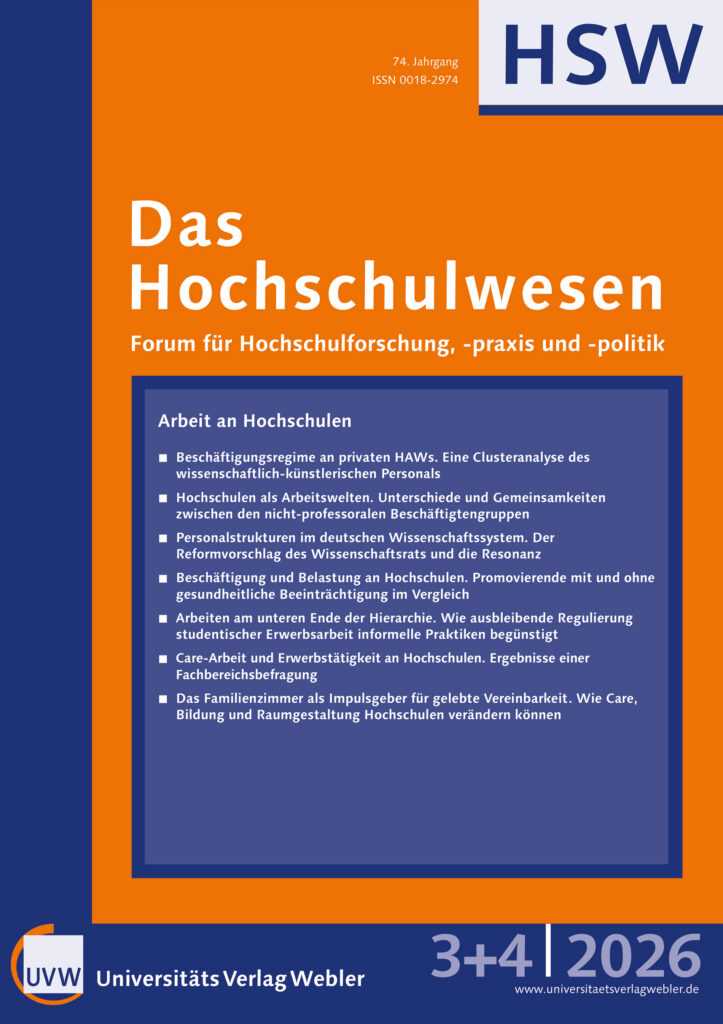
Das Hochschulwesen – Ausgabe 2026|3+4
Beiträge in diesem Heft Sparte: Hochschulforschung Ester Höhle & Okka Zimmermann Beschäftigungsregime an privaten HAWs. Eine Clusteranalyse des wissenschaftlich-künstlerischen PersonalsBeschäftigungsregime an privaten HAWs. Eine Clusteranalyse des wissenschaftlich-künstlerischen Personals (ePaper) S. 59-68 Ulf Banscherus Hochschulen als Arbeitswelten. Unterschiede und Gemeinsamkeiten zwischen den nicht-professoralen Beschäftigtengruppen S. 69-79 Franziska Deutschmann & Toya-Tahnee Heller Beschäftigung und Belastung an Hochschulen.…
40,00 € – 41,00 € -
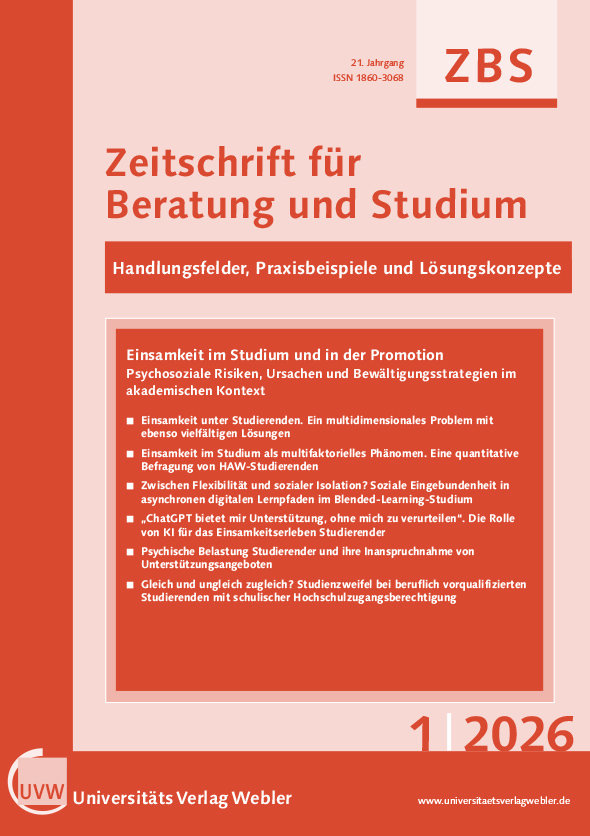
Zeitschrift für Beratung und Studium – Ausgabe 2026|1
Beiträge in diesem Heft Sparte: Themenschwerpunkt Vanessa Wenig & Katherina Heinrichs Einsamkeit unter Studierenden. Ein multidimensionales Problem mit ebenso vielfältigen Lösungen S. 2-4 Ester Höhle Einsamkeit im Studium als multifaktorielles Phänomen. Eine quantitative Befragung von HAW-Studierenden S. 5-10 Birte Lüders Zwischen Flexibilität und sozialer Isolation? Soziale Eingebundenheit in asynchronen digitalen Lernpfaden im Blended-Learning-Studium S. 11-16…
24,00 € – 25,50 € -

Gleich und ungleich zugleich? Studienzweifel bei beruflich vorqualifizierten Studierenden mit schulischer Hochschulzugangsberechtigung (ePaper)
Abstract: About a quarter of all students in Germany enter higher education having already completed vocational education and training (Kroher et al. 2023). At the same time, many students experience doubts about their studies and consider dropping out (Next Career 2021). When deciding whether to continue or discontinue their studies, students with pre-tertiary vocational qualifications…
7,95 € -
Psychische Belastung Studierender und ihre Inanspruchnahme von Unterstützungsangeboten (ePaper)
Abstract: Students show a higher prevalence of mental disorders compared with the general population. The psychological distress seems to be even increasing over the last years. This study examines the current mental health status of university students and their use of support services such as ‚Psychisch fit studieren‘ and ‚Mental health first aid‘. Although nearly…
4,95 € -

„ChatGPT bietet mir Unterstützung, ohne mich zu verurteilen“. Die Rolle von KI für das Einsamkeitserleben Studierender (ePaper)
Abstract: Generative AI chatbots are increasingly used by university students for emotional support beyond academic purposes. This exploratory study examined how AI-based interactions relate to loneliness and perceived support among students. In an online survey (N = 137), students reported moderate levels of loneliness, with about one third experiencing elevated loneliness. Perceived social support from…
5,95 € -

Zwischen Flexibilität und sozialer Isolation? Soziale Eingebundenheit in asynchronen digitalen Lernpfaden im Blended-Learning-Studium (ePaper)
Abstract: Loneliness is increasingly discussed as a psychosocial risk in higher education, particularly in digital and flexible study formats. This article examines how asynchronous digital learning paths in blended learning courses affect students’ experiences of social connectedness. Based on a mixed-methods study with teacher education students, the findings show that social connectedness does not emerge…
6,95 € -

Einsamkeit im Studium als multifaktorielles Phänomen. Eine quantitative Befragung von HAW-Studierenden (ePaper)
Abstract: Loneliness among students is a growing problem in the university context. This study investigates which aspects influence the experience of loneliness and what role loneliness plays in student satisfaction and the development of thoughts about dropping out. In a recent university project, 290 students were surveyed quantitatively. The results of the regression models show…
6,95 €
Filteroptionen

Der Fachverlag für Wissenschaft und Hochschule
Reepeweg 5
33617 Bielefeld
0521 923610-0
info@universitaetsverlagwebler.de
Social Media
Rechtliches
Alle Preise inkl. MwSt.