
Der Fachverlag für Wissenschaft und Hochschule
Shop
Ergebnisse 41–60 von 769 werden angezeigtNach Aktualität sortiert
-

Einsamkeit unter Studierenden. Ein multidimensionales Problem mit ebenso vielfältigen Lösungen (ePaper)
Abstract: Students, mostly young people in the phase of emerging adulthood, often experience emotional, social, and existential loneliness. The experienced loneliness can have relevant consequences for academic performance and thus, further endanger students’ mental health – which is at risk in the first place. Factors leading to loneliness can be localised on personal and inter-personal,…
3,95 € -
Zwischen Befristung und Berufung: Personalentwicklung im unsicheren Wissenschaftssystem (ePaper)
Abstract: Universities operate within a system of structural uncertainty and unequal employment conditions. Human Resource Development (HRD) therefore faces the challenge of ensuring both operational stability and innovation-oriented development. Ambidextrous HRD can meet this challenge by simultaneously maintaining routines (exploitation) and promoting forward-looking developmental processes (exploration). Central to this is empowerment: HRD creates transparent structures,…
8,95 € -
What about Metawork? Ein Überblick über die Arbeit hinter der Arbeit (ePaper)
Abstract: This article provides a systematic overview of the concept of metawork. Based on research, definitions, key characteristics, and fields of activity are presented, along with drivers and possible courses of action. The find-ings underscore the relevance of the concept for business and education. This leads to the realization that there is a possibility to…
8,95 € -
Lehrende im Fernstudium: KI als Treiber neuer Kompetenzen (ePaper)
Abstract: This position paper examines the use of artificial intelligence in distance education from the perspective of instructors. While research and practice have primarily focused on student use, the role of educators remains under explored. Based on key building questions, the paper analyzes opportunities and limitations of AI integration and derives emerging competency requirements for…
6,95 € -

Die Rolle des Preboardings in der modernen Talentbindung: Ein Praxisbericht aus dem Karlsruher Institut für Technologie (ePaper)
Abstract: Long periods between signing a contract and starting vocational training often lead to uncertainty, loss of contact, and dropouts, especially among young people. Studies show that limited communication during this phase weakens emotional attachment to the employer. Structured preboarding helps by maintaining early contact, providing orientation, and creating a sense of belonging. The example…
5,95 € -
POE-Gespräch: „… raus aus der PE …“ (ePaper)
Abstract: Human resources development is often seen as a clearly defined professional field – but is it really a career dead end? Or does it, in fact, open up a wide range of opportunities both within and beyond the organization? We explore this question in the following interview. Our interviewee brings many years of experience…
4,95 € -

Personal- und Organisationsentwicklung – Ausgabe 2026|1
Beiträge in diesem Heft POE-Gespräch POE-Gespräch zwischen Anke Diez und Katrin Klink über „… raus aus der PE …“ S. 3-6 Anregungen für die Praxis/Erfahrungsberichte Sabrina Heinze Die Rolle des Preboardings in der modernen Talentbindung: Ein Praxisbericht aus dem Karlsruher Institut für Technologie S. 7-11 Personal- und Organisationsentwicklung/-politik Petra Strohmann Lehrende im Fernstudium. KI als…
24,00 € – 25,50 € -

HSW-Gespräch: Micro-Credentials in Ireland (ePaper)
Abstract: Ireland is widely regarded as a pioneer in the field of microcredentials in higher education and beyond. To gain deeper insight into the thinking, policy rationales, and practical approaches shaping this development, Imke Buß and Olaf Bartz conducted an interview with Bryan Maguire. He is a Director at Quality and Qualifications Ireland (QQI) and…
4,95 € -
Hochschulreputation unter Druck: Arbeitsmarktsignale statt Exzellenzlabel (ePaper)
Abstract: In the context of growing attention to reputational signals in higher education, we test whether educational background and institutional reputation predict professional performance, using N = 152 observations of top fund managers in the DACH region. The dependent variable is fund outperformance. Predictors include individual degrees and quantifiable reputation of the alma mater. Random-effects…
8,95 € -

Micro-Credentials in Europa: Stand der politischen Implementierung laut aktueller EU-Analyse (ePaper)
Abstract: The 136-page Progress Report published by the European Commission at the end of 2025 provides an up-to-date EU-level overview of the implementation of the 2022 Council Recommendation on “A European approach to micro-credentials for lifelong learning and employability” across the 27 EU Member States as well as Iceland, Liechtenstein, and Norway. The report is…
4,95 € -
Ausstellung und Verifizierung digitaler Micro-Credentials über Europass (ePaper)
Abstract: This article explores the technical implementation of digital micro-credentials using the MC4Data project at the Technische Hochschule Nürnberg (Nuremberg University of applied sciences, Germany) as a case study. Because of digital transformation and the increasing need for flexible and transparent competency recognition, the article analyses key requirements including interoperability, data protection, verifiability and user…
11,95 € -

Das Hochschulwesen – Ausgabe 2026|1+2
Beiträge in diesem Heft Sparte: HSW-Gespräch HSW-Gespräch mit Bryan Maguire Micro-Credentials in Ireland S. 3-6 Sparte: Hochschulentwicklung/-politik Ulrike Tippe & Tilman Dörr Lernformate für flexible Bildungswege: Microcredentials aus Hochschulperspektive S. 7-12 Beatrix Busse & Malte Kneifel Microcredentialing in der grundständigen Hochschullehre: Mögliche Wege, Chancen und Hürden S. 13-19 Carolin Gläser Micro-credentials als gemeinsamer Bezugsrahmen: Abgrenzung…
40,00 € – 41,00 € -

Microcredentials in der wissenschaftlichen Weiterbildung: vom Strukturimpuls zur Abschluss- und Formatinnovation (ePaper)
Abstract: As a qualification and course format, microcredentials offer new prospects for the standardisation of compact continuing education programmes at universities. The so-called transparency grid is used to explain how microcredentials can be systematised in academic continuing education. The main reference system here is the Bologna Process, which provides both a competence and a quality…
5,95 € -

Micro-credentials als gemeinsamer Bezugsrahmen: Abgrenzung zu klassischen Weiterbildungsangeboten in einer europäischen Hochschulallianz (ePaper)
Abstract: This article discusses the role of micro-credentials in the UNINOVIS European university alliance, highlighting their potential to establish a shared understanding of learning opportunities across institutions. Unlike traditional continuing-education offers, which are often fragmented and lack common standards, micro-credentials can create transparency, comparability, and transferability – provided they are developed in line with the…
7,95 € -

Microcredentialing in der grundständigen Hochschullehre: Mögliche Wege, Chancen und Hürden (ePaper)
Abstract: This article explores how micro-credentialing can be integrated into undergraduate higher education. Following a conceptual comparison of micro-credentials and ‘traditional’ university teaching in terms of goals, formats, methods, and crediting, three scenarios are discussed: as supplementary learning opportunities, as curricular components, and as foundational units. The analysis suggests that integration as additional opportunities or…
6,95 € -
Lernformate für flexible Bildungswege: Microcredentials aus Hochschulperspektive (ePaper)
Abstract: This article examines the role of Microcredentials – defined as short, competency-based, quality-assured learning units – in higher education, analysing their potential to complement traditional degree programmes while addressing the demands of lifelong learning, individualised learning pathways and labour market dynamics from an HRK-related perspective. The article highlights universities’ dual role as providers and…
6,95 € -

Optimierung universitärer Transferstrukturen: Handlungsempfehlungen für universitäre Tochtergesellschaften zur effektiven Unterstützung von und Beteiligung an akademischen Spin-offs (ePaper)
Abstract: Academic spin-offs translate research findings into marketable innovations and are a key mechanism of the Third Mission – the transfer of knowledge and technology from universities to society and the economy. Spin-offs are managed by university Technology Transfer Offices (TTOs). Organizing this function within a subsidiary dedicated to participating in and promoting spin-offs offers…
5,95 € -
Einfluss der Lernkultur auf die Technologieakzeptanz in Organisationen (ePaper)
Abstract: This article is based on a research project that investigates the influence of organizational learning culture on technology acceptance, as well as the role of targeted management control instruments in this process. Through a longitudinal study conducted during the early stages of technology implementation, the project aims to generate scientific insights into the relationships…
4,95 € -

Neue Lehrformate, um Kreativität und Innovation zu fördern (ePaper)
Abstract: Digital transformation and change are drivers of business these days. How can we teach the necessary skills and competences? An innovative teaching format combines Problem-Based Learning (PBL) with Design Thinking to equip students with skills in transformation and innovation. In a first step they gain the knowledge about ERP systems and smart technologies and…
5,95 € -
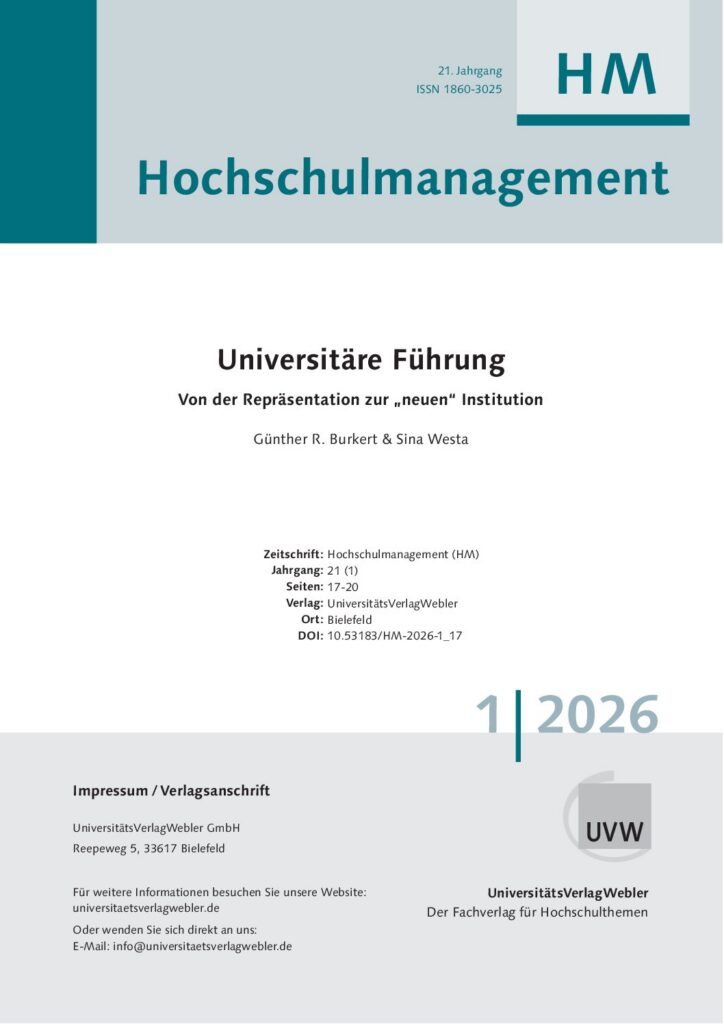
Universitäre Führung: Von der Repräsentation zur „neuen“ Institution (ePaper)
Abstract: This article examines the evolution of university leadership in Austria, focusing on the role of the rector from a historically representative figure to a managerial leader shaped by successive governance reforms. Through an analysis of 143 rector biographies since 1975, the study explores the tension between academic and managerial identities, particularly in the context…
4,95 €
Filteroptionen

Der Fachverlag für Wissenschaft und Hochschule
Reepeweg 5
33617 Bielefeld
0521 923610-0
info@universitaetsverlagwebler.de
Social Media
Rechtliches
Alle Preise inkl. MwSt.