Abstract:
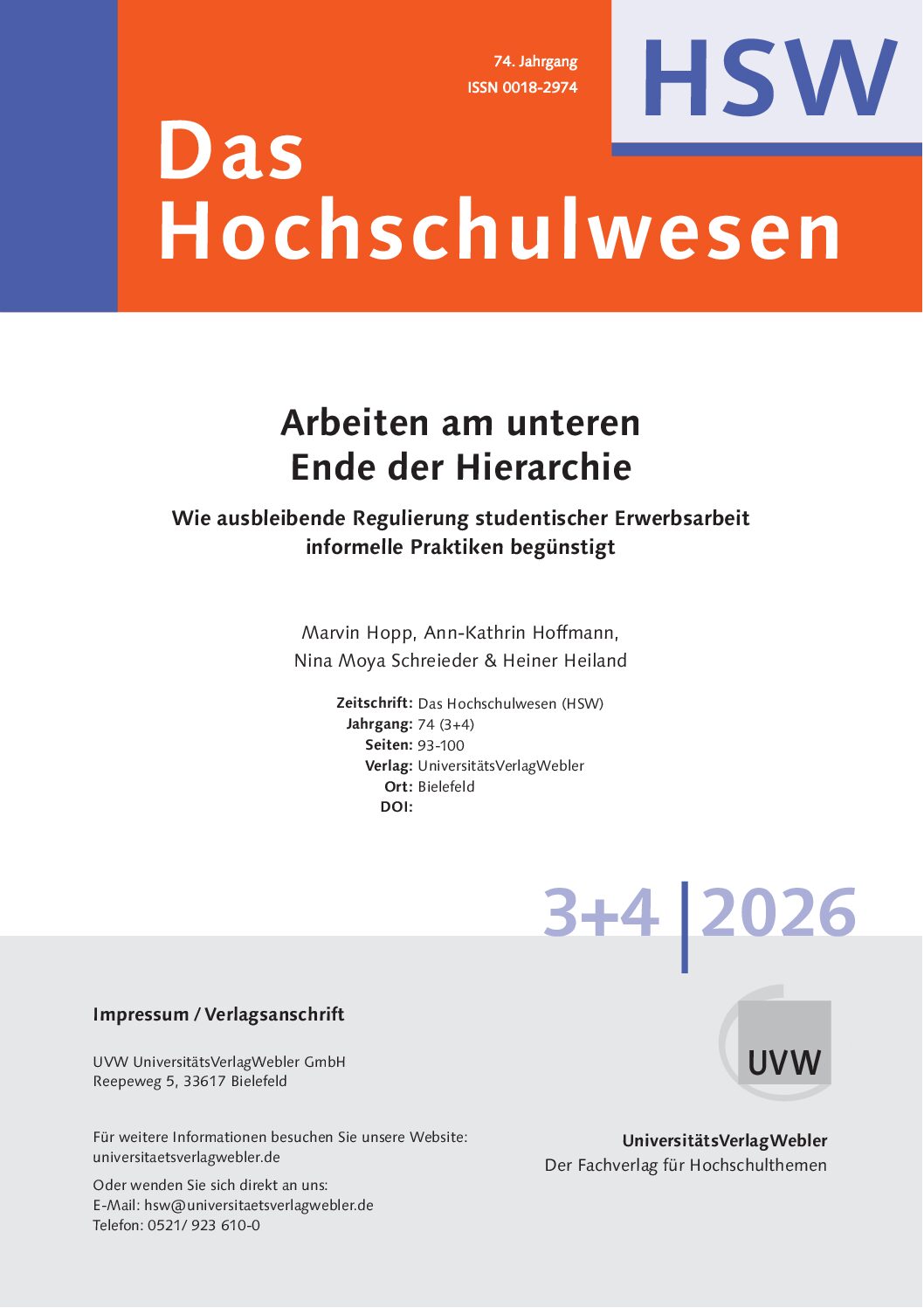
Student employees are among the largest yet least researched groups within German higher education. Despite their importance they remain only partially integrated into the regulatory framework governing employment relations in the public sector. Drawing on concepts of labour relations, precarity, and informality, this article examines how different regulatory arrangements shape their working conditions. The analysis is based on a nationwide survey of student employees conducted in 2025 (N = 5,827). Comparing three regulatory scenarios, the findings show that weaker forms of regulation are associated with higher levels of informal recruitment, shorter and more fragmented contracts, unpaid overtime, and lower compliance with labour standards. Conversely, stronger institutional protections – such as collective agreements, staff representation, and minimum contract durations – are linked to more stable and formalized employment conditions.
Über die Autor*innen:
- Marvin Hopp,
wiss. Mitarbeiter im Arbeitsbereich Soziologie mit den Schwerpunkten Arbeit, Unternehmen und Wirtschaft am Institut für Soziologie der Universität Göttingen - Ann-Kathrin Hoffmann,
Masterstudentin Erziehungswissenschaft und Geschichte an der Ruhr-Universität Bochum - Nina Moya Schreieder,
Masterstudentin der Digital Humanities an der Universität Wien - Heiner Heiland,
Dr., wiss. Mitarbeiter im Arbeitsbereich Digitalisierung der Arbeitswelt am Institut für Soziologie der Universität Göttingen